The Syrian Gnostic Schools drew from heavily from Judaic teaching and thought, as well as that of Platonic school. Their foundations appear to have emanated from the city of Antioch. The surviving teachings suggest that the creation occurred in a series of stages, with the final creation being that of a universe comprising of matter. However this material universe was considered to be primarily evil with the earlier creations, non-material in nature, as being good. Evil lacks insight in as much as it is in opposition to goodness, yet it is not seen as being of equal standing. “Good” and “Evil” do not refer to sin and a choice but as descriptive terms within human existence and the distance between goodness, the Plemora and oneness with God and the Logos, whereas evil is being confined within a world of matter. Neither Good nor Evil have inherent positivity nor negativity respectively in relation to human behaviour or psyche. The schools themselves identified themselves as Christians, however markedly different and most unlike the Christian doctrine that was to become the orthodox school of thought.
Following the discoveries of the library of codices made at Nag Hammadi, a significant number of works which appear to have followed the ideas were found and have been translated. These gospels and treatises generally follow a tradition named Sethian, after Seth, the third son of Adam and Eve, who was thought to be the possessor and disseminator of the original gnosis. Furthermore, those who considered themselves directly descended from Seth considered themselves to be amongst the elite, therefore worthy of achieving gnosis. The Sethians are identified through their detractors, described by G.R.S. Mead as being the “foes” of the Gnostics. Their existence is mentioned in the works of Irenæus and also in an anonymous work condemning the Gnostics as heretics by an author named Pseudo-Tertullian, who also is attributed with the writing of a poem against Marcion. It has been suggested by some scholars that Sethian thought and teachings actually pre-date Christ and that Christian ideas and motifs were later adopted into their doctrines. However, according to various Sethian works, Christ is identified as being Seth, which is at odds with the ideology that Sethianism predated the various cults of Christ. The God as seen by the Sethians is one that is beyond description, it is only possible to describe what he isn’t, indescribable through and by rational description.
Four of the early, lesser-known exponents and teachers of Syrian Gnosticism, together with a brief biography and explanation of their doctrines are given below:
MENANDER.
Menander was one of Simon Magus’ followers who propagated Sinonian thought and teaching to such a degree that one of the Early Church writers, Justin Martyr, cited previously for having a particular abhorrence for the teachings of the Magus, recorded his existence and the following he appears to have attracted. Justin clearly saw the following that Menander had attracted as being of such a threat to the developing “orthodox” Christianity, certainly given that other early teachers were attracting their own large circles of disciples, that Menander deserved a particular mention. Like Simon Magus, who may or may not have been his teacher, Menander too was from Samaria, born in Capparatea. Menander, based upon his association with Simon is one of the earliest Gnostic teachers, as well as placing him within the obscure timeframe of Early Christianity; Menander seems to have been teaching in the late first/early 2nd century A.D.
The city of Antioch, in modern day Syria was where Menander’s doctrines seem to have attracted the most attention and popularity. Antioch, like Alexandra, was a centre of learning, commerce and ideas; a link between the East and West. The teachings of Menander appear to have been that of an early formative strand of Gnosis; knowledge [gnosis] and enlightenment being attained through transcendental thought, magic not just through faith. The followers of Menander and his doctrines were called Menandrists. The teachings and writing of both teacher and his followers have been lost. The detractors of Menander suggested he believed himself to be imbued with an understanding of the powers and laws of nature, and were subject to a human will and personality. Therefore Menander was more of a hierophant in status than a teacher.
Furthermore, and for this alone Menander might have condemned himself and his teachings, he claimed to be Messiah; a Saviour sent to instruct and teach a path to knowledge to liberate themselves from the lower world, and attain salvation in the gnosis with the higher powers. Much like Simon’s claims to be the Messiah, this “heretical thought” has often been misinterpreted, in that these men were trying to usurp a divine status afforded by God the father unto Jesus, by virtue of faith, his “son”. Both Simon and Menander tought that the Saviour was in fact the Word [“logos”] of God, and that the aspiration was to achieve such a state of perfection that one might be at one with the Logos, thereby becoming “Christ” or a Saviour. According to both Justin Martyr and Irenæus, Menander’s teachings also included the idea that baptism was an internal purification giving immortality to the soul, rather than immortality upon the final death on the final day of Judgment in Orthodox Christian teaching.
Menander is not to be confused with the Athenian playwright of the third century BC with the same name, nor in relation to the house in Pompeii, referred to in modern terminology as “The House of Menander”, owned by Quintus Poppaeus. Some scholars have named Menander as being a “proto-Gnostic” and have suggested that his doctrines might even predate those of Simon Magus; other sources have suggested that Menander travelled into Syria and was responsible for the founding of Zaroastrianism thought.
SATURNINUS
Saturninus [or Satornilos in Greek] is believed to have come from Antioch, and has been named as being the father of Syrian Gnosticism. Much like Menander, this branch of Gnosticism seems to have been a very strong and powerful branch of early Christianity, inasmuch that Justin Martyr considered him to be of similar standing with the other leading schools of Gnostic teaching and thought of the time; those of Marcion, Basilides, and Valentinus. Tradition has often suggested that Saturninus was the student of Menander, and that his student was Basilides, who in turn was the teacher of Valentinus; one of the most important, intelligent and highly regarded of all the Gnostic teachers, and who’s doctrine of Christianity posed the most serious “threat” to the orthodox traditions that the Early Church fathers were writing their respective Apologies and condemnations against “knowledge falsely told” [i.e. gnosis].
Of Saturninus, nothing is recorded of his origins nor any biographical details, but is believed to have been either Greek or Syrian based on that his teachings appear to have originated from Antioch. Based upon the ethics and conduct of his followers, he seems to have been a particularly strict ascetic. A strict sense of abstinence seems to have been part of his doctrine, with its abstaining from marriage, and they were strict vegetarians. This encratism would have been very attractive to the very devout, almost zealous in their devotion.
Very little information survives in regard to Satuninus and his doctrines. Again, one is reliant upon the writings of his detractors, in particular that of Irenæus, which in turn is probably derived from a lost work, possibly The Compendium, by Justin Martyr. Saturninus appears to have taught a particular theology which detailed the hierarchies of the Uknown father and his builders; the archangels, angels, and the powers. He also writes of an anthropomorphic World-saviour, who although appearing as a man, was not in fact a man at all. This Saviour would defeat evil, but also be the salvation of those with the gnosis within them. An intriguing difference between Saturninus and Canonical tradition was that Man (more precisely, his outer shell, called the “plasm”) was created by the angels. His creation was based upon a fabrication of a perfect example being shown to the angels and their endeavours to create something of a similar nature based upon the memory of what they once saw. After man’s death, the spark within the plasm returns to the plemora.
BASILIDES
According to the writings of Eusebius, Basilides was Alexandrian in origin, and his teachings flourished in the early decades of the second century AD. Much like the other prolific Gnostic teachers, their detractors in the form of the Early Church fathers wrote very little in terms of biographical detail, however it appears that Basilides was married and had a son called Isidore, who’s teachings followed those of his father. The opponents of Basilides’ teaching dismissed his claims of having received his teachings from St. Matthias, apostle of St. Peter, as being spurious in nature. Basilides appears to have been highly educated in nature, most probably educated in Hellenic thought and culture, as well as in Egyptian wisdom.
Practically nothing survives of Basilides and his original teachings are sadly lost to us, other than, as with other early non Proto-Orthodox teachers, through the condemnation of his ideas and teachings by Irenæus, by Hippolytus, by Clement of Alexandria and by the writer known as “Pseudo-Tertullian”. One of the most intriguing surviving records of Basilides survives not in writing, but in Abrasax or Abraxas stones. Abrasax stones, sometimes semi-precious, are usually small in size and inscribed with the name “Abraxas” [ΑΒΡΑΣΑΞ], and mythical beasts. The purpose of these is unknown, however it has been suggested that they were protective charms. Magical papyri have been found with the name of Abraxas, and the name is mentioned in various Gnostic texts, including some of those found at Nag Hammadi. One of the finest examples of these Abraxas stones was found in the United Kingdom, in the Thetford Trove. Sadly the Thetford Trove is one of the tragedies of recent excavation and will be discussed elsewhere in greater detail. However, for the moment, it is sufficient to note that an Abraxas stone was found as far afield as Norfolk in England. Different interpretations have been given as to the meaning behind these stones and the word “Abraxas”; these have been proposed as meaning the order of the planets according to the Gnostic method of astronomy to Abraxas being a Gnostic deity. The etymology behind the name remains obscure and open to much interpretation by scholars.
Basildes’ teachings, as interpreted by Irenæus were that the Nous [Mind] was first to be born or created by the Unborn Father. From Nous came the Logos [Word, or Reason], which in turn lead to Phronesis [Prudence] being born, and who was father in turn of Dynamis [Strength] and Sophia [Wisdom]. Dynamis in turn was father to the Virtues, to the Principalities, and the Archangels. A series of heavens were created by the Archangels until there were 365 in total, therefore as many heavens as there were days in the year. The first of these Archangels was the god of the Jews, however he sought to make all the other archangels and beings subservient to his will. This manner and behaviour was the cause of the subsequent animosity against the Jews. Aware of this attempt at creating a hierarchy, the Unborn Father sent the Nous in the form of Jesus Christ to deliver His followers from damnation. Basilides further suggested that it was not Jesus who was crucified on the cross, but that it was Simon of Cyrene who was crucified in his stead. This suggestion is echoed in the Gnostic Text “The Second Treatise of the Great Seth”, again of which the only extant copy was found at Nag Hammadi. This idea arises from a doctic theology in that Jesus, being divine, could not suffer and did not die on the cross. Thus Simon, together with carrying the cross also took on the physical appearance of Christ and was crucified instead. The idea of a substitution at the crucifixion has been reiterated in Islam, in an ambiguous passage found in the Qur'an.
"Wherefore he did not himself suffer death, but Simon, a certain man of Cyrene, being compelled, bore the cross in his stead, so that the latter being transfgured by him, that he might be thought to be Jesus, was crucified, through ignorance and error,while Jesus himself received the form of Simon, and, standing by, laughed at them. For since he was an inceorperal power, and the Nous [Mind] of the unborn father, he transfigured as he pleased, and thus ascended to him who had sent him, deriding, inamuch as he could not be laid hold of, and was invisble to all." [Irenæus: Against Heresies]
"That they said [in boast], 'We killed Christ Jesus the son of Mary, the Messenger of Allah';- but they killed him not, nor crucified him, but so it was made to appear to them, and to those who differ therein are full of doubts, with no (certain) knowledge, but only conjecture to follow, for of a surety they killed him not." [Qur'an, sura 4 (An-Nisa) avat 157-158].
Therefore, with Simon having taken Jesus’ form, was crucified instead, and Jesus was returned to his Father. Therefore through knowledge [gnosis] of Christ, the soul is saved even if the body perishes. The later fathers condemn this teaching for it devalues martyrdom, as it suggests that men did not die for Christ, but for Simon of Cyrene.
Basilides seems to have been a prolific writer, despite the fact that none of his writings have survived. Sources however do make reference, though sadly do not quote directly, to a number of these works. Reference is made in Origen (and subsequently in the writings of Saints Jerome and Ambrose) that Basilides had written his own gospel. Whether this gospel was Gnostic in nature to Basilides’ own teachings and beliefs or like The Diatessaron by Tatian, we cannot know. Basilides also wrote various “hymns” or “odes”, again referenced, and dismissed, in Origen as being un-canonical. Finally a “Gospel commentary” in twenty four books was written. Only fragments survive in the Stromata of Clement of Alexandria.
In addition to these few fragments that Clement has preserved, there is some hints given as to the ethics behind the teachings of Basilides. It was through faith that started the spiritual life, however this was the gift of Gnosis (knowledge/understanding) was bestowed to various individuals and not to others upon their souls before it became joined with the body. Sin results in suffering and that sin is an inherent internal principle or evil, and that suffering is punishment for this act. Persecution and suffering is as a result of this inherent internal evil, and this had lead the soul to be confused. Basilides believed that only God the Father to have been created without sin. Clement suggests that this attitude of Basilides lead to widespread debauchery amongst his followers, an ideology apparently echoed in the teachings of his son which encouraged satisfaction of sexual and sensual desires, a radical digression from the acetic ideals of numerous other Gnostics, and that the soul mind find solace in prayer.
Any writings against the Gnostic teachings needs to be approached with caution, as the Gnostics were often portrayed as deviant or perverse in nature, however it is interesting to note that as early as Justin Martyr in the mid second century AD of the possibility that it is the Gnostics who are engaged in such practices, and not the Proto-Orthodox Christians. Basilides’ teachings did not gain as much popularity or recognition as those of Marcion or the dynamic Valentinus, however they do appear to have survived for at least two centuries after his death in parts of Egypt. Basilides' name was to continue in later tradition, with Carl Jung adopting his name as a pseudonym when writing "The Seven Sermons to the Dead."
CERDO
Cerdo appears to have been of Syrian extraction, and to have been teaching just prior to the revolutionary teachings of Marcion of Sinope, probably in around c. 130-135 AD, and his teachings appear to have taken place in Rome. Cerdo appears to have caused a disagreement with the early Christian Church in Rome, and labelled a Gnostic in subsequent times, however quite significantly has not been recorded as having been excommunicated as a result of his beliefs. It was only with the arrival of Marcion and his contentious ideas that the Church, and that the canon of orthodox teachings and theology was still undeveloped and open to ideas rather than the rigidity and condemnation of heresy that was soon to follow.
One source suggests that Cerdo initially recanted his sins of heresy and was welcomed back into the church by the Pope, Hyginus, however he soon after strayed once again into his heretical beliefs and was excommunicated from the church again. It has been implied that Cerdo also taught that Jesus was not the son of the God of the Jews, of the Law, and the Prophets. Other accusations made against Cerdo mirror those later attributed to Marcion; the theology of two gods, and the dismissal of various canonical texts and only selected parts of the Gospel of Luke. Cerdo was therefore possibly condemned for his [apparent] association with Marcion, for it has appears that Marcion took a number of his ideas, developed them and thus created his own ideas and doctrines. Also the Church fathers were to state that Cerdo was a follower of Simon Magus, who they were denounce as being the father of all heresy, and therefore through that association alone, Cerdo would have been condemned as well.

Showing posts with label Neo-Platonism. Show all posts
Showing posts with label Neo-Platonism. Show all posts
Monday, February 13, 2012

Thursday, November 17, 2011
Questioning Fate and Fortune: Boethius and the Consolation of Philosophy.
“It remains” I said “for you to explain this apparent injustice I am suffering now.”
"The question you're asking," Lady Philosophy replied with a smile, "is the grandest of all mysteries, one which can never be explained completely to the human intellect, for, when one problem is removed, many more arise to take its place, and arise and arise unless the mind is keen and awake. For the problem you raise touches on a number of difficult questions: the simplicity of Providence, the nature of Fate, the unpredictability of Chance, divine and human knowledge, predestination, and free will. You know the difficulty involved in these questions; nevertheless, I will try to answer them in the short space allotted us."
Historians seem to be in general agreement as to the events which lead to Boethius’ fall from grace. A former consul, Albinus (Caecina Decius Faustus Albinus) was accused of treason, of treacherous correspondence with Justin, in front of the king and court, by Cyprianus. Boethius, however, stated he believed Albinus to be no more guilty of the accusation than Boethius himself nor the other senators, and took his defence. In retort to this, Cyprianus turned and Boethius indicted of the same crime.
The religious beliefs of Theodoric were Arian in nature, and this was to cause quarrels between his subjects, some Catholic, some Arian. Justin entertained good relations with Hilderic, king of the Vandals, and this contributed to a turbulent relationship between the two realms. In addition, the beliefs of Theodoric (and most of the nobility) stood in marked contrast to those following the resolution of the Acacian Schism in 519, whereby Christ had been recognised as divine; a complete antithesis of the Arianist theology. Theodoric’s sister Almafrida, dowager queen of the Vandals, had raised an unsuccessful revolt against the successor of her late husband, his cousin Hilderic. Her husband had sought to forge better relations with Byzantium, by ceasing the persecution of the Catholics within his kingdom. Hilderic, continued his predecessor’s ways and empathy for the Catholics, allowing many of his subjects to convert; he thus achieved even greater ties with Byzantium and further alienated the Arians. This resurgence of Catholic strength led to a subsequent persecution of Arians in the East. Hilderic had Almafrida imprisoned, and she was possibly executed, or died in prison. It was only due to the death of Theodoric that the two nations didn’t go to war at that point in time. However the animosity between Byzantium and Italy was great. However the animosity between Arians and Catholics was to continue; with a victorious revolt in the Vandal Kingdom in North Africa, seven years later, lead by Hilderic’s cousin Geilamir.
“But the King [ie Theodoric] summoned Eusebius, Prefect of the city of Ticenum, and without giving Boethius a hearing, passed sentence upon him. The King soon afterwards caused him to be killed on the Calventian territory where he was held in custody. He was tortured for a very long time by a cord that was twisted round his forehead so that his eyes started from his head. Then at last amidst his torments he was killed with a club.”
The Gnostic traditions taught that Sophia [meaning “Wisdom”] was the feminine aspect to God. She was the embodiment of knowledge, and understanding. Some Gnostic schools taught that Sophia was the Mirror of God. However to add confusion, this Sophia had a daughter, also called Sophia, who left the plemora, or a divine plain, and became lost and confused below. So as to keep herself company created Yaldaboath [meaning “child of chaos”], a creature that was half lion, half serpent. However this creature terrified her and she built an enclosure around him, thus separating the world from the Underworld. Then either Yaldaboath or Sophia, the stories differ, created Man. Sophia herself can be interpreted as being metaphorical of the human soul; lost and confused, yet still containing the spark, or gnosis, within her.
The fifth and sixth centuries were to demonstrate an important time in the development of the Christian Church. The conflict between pagan ideas and those taught within Scripture were coming to an end. Through the proscription of various books which betrayed different ideas on accepted Christianity, and the compilation of a complete canon of accepted books by Athanasius in 381 A.D., Christianity at last had some element of structure as to what was orthodox, and what was heterodox. Anything, be it other’s doctrines, teachings, or even alternative gospels and strands of Christianity (such as those of the Sethians, Manichees, etc) could be denounced as being heresy and be suppressed wherever and whenever possible. For a brief while, Christianity and classical “pagan” traditions could co-exist alongside each other, however with Scripture as “the inspired word of God” taking precedence over that which had been written by non-believers in the “true word”. However, Scripture was to become a prevalent force, and rational, scientific thought was discouraged. To the modern mind this might seem preposterous, however it serves as a valid reasoning as to why so many synods and ecumenical councils were held during the fourth and fifth century. In essence, a “blueprint” had to be drawn up, and the Church had to be unified in her message, not be teaching divergent ideas that, at times, were plainly conflicting with one another. It was only with the Renaissance, some eight to nine centuries later, that science, logic and philosophy was “rediscovered” outside of the message contained in Scripture, and given a new sense of purpose and worth, and could be taken seriously, and considered as a valid, alternative standpoint to the “word of God.”
The Consolation of Philosophy has left an important legacy for readers since its completion and circulation from the sixth century onwards. The work has inspired numerous writers, not just in the Mediaeval and Renaissance era when at its most popular; the both has influenced Dante, Chaucer, Shakespeare, to recent writers as diverse as J.R.R. Tolkien and John Kennedy Toole. It was translated many times, amongst its notable translations having been made by Alfred the Great, Chaucer, and queen Elizabeth I. Numerous translations have been circulated throughout the ages and the work is still available today; a true testament to the work’s enduring appeal and popularity in the present as much as in the past.
Then, as though she were beginning for the first time, Philosophy said, "The coming-into-being of all things, and the entire course that changeable things take, derive their causes, their order, and their forms from the unchanging mind of God. The mind of God set down all the various rules by which all things are governed while still remaining unchanged in its own simplicity. When the government of all things is seen as belonging to the simplicity and purity of the divine mind, we call it “Providence.” When this government of all things is seen from the point of view of the things that change and move, that is, all things which are governed, from the very beginning of time we have called this “Fate.” We can easily see that Providence and Fate are different if we think over the power of discernment each has. Providence is the divine reason, the divine logos , and only belongs to the highest ruler of all things: it is the perspective of the divine mind. “Fate,” on the other hand, belongs to the things that change and is the way in which Providence joins things together in their proper order. Providence views all things equally and at the same time, despite their diversity and seemingly infinite magnitude. Fate sets individual things in motion once their proper order and form has been established. In other words, Providence is the vision of the divine mind as it sees the unfolding in time of all things, and sees all these things all at once, whereas the unfolding of these events in time, seen as they unfold in time, is called Fate. Even though the two are different, the one depends on the other, for the complex unfolding of Fate derives from the unity of Providence. Think of it this way: a craftsman imagines in his mind the form of whatever thing he intends to make before he sets about making it; he makes it by producing in time through a succession of acts that thing that he originally conceived of in his mind. God, in his Providence, in a unified and simple way, orders all things that are to be done in time; Fate is the unfolding in time through a succession of acts in the order God has conceived. Therefore, whether or not Fate is worked out by angelic spirits serving God, or by some "soul," or nature, or the motions of the stars, or the Devil himself, or by none or all of these, one thing you can be certain of: Providence is the unchangeable, simple, and unified form of all things which come into and pass out of existence, while Fate is the connection and temporal order of all those things which the divine mind decided to bring into existence. This leads to the conclusion that all things subject to Fate are in turn subject to Providence; therefore, Fate itself is subject to Providence.
[Boethius: Consolatio Philosophiae, Book IV, Prose VI.]
Anicius Manlius Severinus Boethius, more often referred to as just Boethius , was a statesman and philosopher who lived in the sixth century A.D. He was educated and high born, descended from an early Roman noble family, and was author of numerous books including commentaries on Aristotle; he wrote his Consolatio Philosophiae [hereafter referred to under the translated name of The Consolation of Philosophy] whilst in prison in 523/24 A.D. He had achieved much during his life, being appointed Consul of Rome in 510 A.D. and had seen his sons become joint consuls twelve years after. Boethius was responsible for the translation of numerous Greek teachers’ works in Latin, including works by Ptolemy on astronomy, Euclid on geometry, and those of Plato and Aristotle. Shortly before his imprisonment, he was appointed as magister officiorum to Theodoric I, ruler of Italy. Boethius was accused as being a sympathiser of Justin I, Emperor of Byzantium, a former career soldier who had risen through the ranks and been elected emperor. Justin’s nephew, later adopted as his son, was Justinian I, and husband of the notorious empress, Theodora. Indeed it was owing to a repeal of certain laws by Justin, preventing the royal family from marrying women of low rank such as actresses, that his nephew was able to marry Theodora, allegedly a former prostitute and actress.
 |
| A Mediaeval representation Boethius, visited by Lady Philosophy. |
Three witnesses were presented to demonstrate Boethius’ guilt (and quite probably that of Albinus alongside him) in the affair. These witnesses’ testimony was denounced by Boethius as being dishonourable as they had previously been petty criminal behaviour, with one having been exiled for his debts, and the other two of fraud. However, sources differ as to the veracity of the statements and the good character of these three witnesses. Nonetheless, Boethius was arrested, initially detained in church, and then under house arrest. It was whilst he was under house arrest that Boethius was executed. A number of extenuating factors may have contributed towards, if not hastened, Boethius’ end.
Theodoric’s origins were being born of Ostrogothic royalty, as a child he had been sent as a royal hostage to Byzantium where it appears he was educated in the ways of Government. In his thirties, the Byzantine emperor Zeno appointed Theodoric as his consul based upon his successes as a soldier. Zeno also allowed him to return to his own people where, soon after, he was crowned king following the death of his father, Theodemir. Soon after, at Zeno’s suggestion and the promise of the Italian peninsula; Theodoric invaded Italy where the existing viceroy Odoacer was being seen as an increasing threat. Following a three year siege and a treaty made between both sides, Theodoric slew Odoacer with his sword at Ravenna. Theodoric then set about slaying his family and remaining supporters. Soon after, Theodoric was appointed as king of Italy.
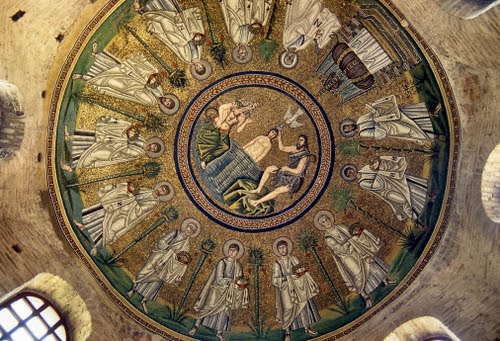 |
| The Battistero degli Ariani [The Baptistry of the Arians] in Ravenna, believed to have been built by Theodoric. |
The religious beliefs of Theodoric were Arian in nature, and this was to cause quarrels between his subjects, some Catholic, some Arian. Justin entertained good relations with Hilderic, king of the Vandals, and this contributed to a turbulent relationship between the two realms. In addition, the beliefs of Theodoric (and most of the nobility) stood in marked contrast to those following the resolution of the Acacian Schism in 519, whereby Christ had been recognised as divine; a complete antithesis of the Arianist theology. Theodoric’s sister Almafrida, dowager queen of the Vandals, had raised an unsuccessful revolt against the successor of her late husband, his cousin Hilderic. Her husband had sought to forge better relations with Byzantium, by ceasing the persecution of the Catholics within his kingdom. Hilderic, continued his predecessor’s ways and empathy for the Catholics, allowing many of his subjects to convert; he thus achieved even greater ties with Byzantium and further alienated the Arians. This resurgence of Catholic strength led to a subsequent persecution of Arians in the East. Hilderic had Almafrida imprisoned, and she was possibly executed, or died in prison. It was only due to the death of Theodoric that the two nations didn’t go to war at that point in time. However the animosity between Byzantium and Italy was great. However the animosity between Arians and Catholics was to continue; with a victorious revolt in the Vandal Kingdom in North Africa, seven years later, lead by Hilderic’s cousin Geilamir.
Over the year in which Boethius was imprisoned he wrote The Consolation of Philosophy. Sometime after its completion, Boethius was executed. In respect of Boethius’ final days, the fragmentary chronicle Anonymous Valesii states:-
“But the King [ie Theodoric] summoned Eusebius, Prefect of the city of Ticenum, and without giving Boethius a hearing, passed sentence upon him. The King soon afterwards caused him to be killed on the Calventian territory where he was held in custody. He was tortured for a very long time by a cord that was twisted round his forehead so that his eyes started from his head. Then at last amidst his torments he was killed with a club.”
The work itself is a significant deviation from all the others in Boethius’ catalogue of writings in that it is of a personal nature, and not a translation nor a commentary of earlier philosophy or doctrine. Within those words, Boethius imbues the work with themes from relevant works in his library, seemingly of pre-Christian writers. The work, although much of the ideas are commentary or derivative of other sources; this does not detract from the importance of the underlying theme, nor does it make the work any less stimulating to read and to allow the reader to contemplate. The informed reader of the work however will ponder two questions whilst reading and reflecting upon Boethius’ words whilst reading this work however. The first being that of Boethius’ guilt in the crime for which he had been accused and the second one being the question mark over Boethius’ faith and beliefs.
To address the question of Boethius' beliefs, it is perhaps reflective of the environment in which he found himself, Boethius, much like St. Jerome a century previous found himself drawn to the works of Cicero and Plato. Indeed, The Golden Legend recounts a tale of how St. Jerome converted to Christianity upon the threat of being whipped and condemned as a pagan upon his reading of Cicero and Plato, both deemed and condemned as being heretical texts, yet by stalk contrast, Boethius seems to have enjoyed respect rather than condemnation for his appreciation of the two same (amidst many others) authors from antiquity. Indeed, in reading The Consolation of Philosophy, it becomes highly apparent how much the Early Church was to appropriate pre-Christian writers and philosophy into its teachings. Boethius makes extensive reference to the works of Cicero, and there is a deep Platonist feel which is found throughout the work, yet perhaps rather extraordinarily, there is not a single reference made to Scripture. This is extraordinary in retrospect, as the book as much its author, was to be venerated by Christians for many centuries after. Boethius admittedly did not have access to his library whilst imprisoned, however his source of salvation does not seem to have been found that of the Christian message, and it is Lady Philosophy who teaches him the importance of virtue. Boethius’ writing seems to have been influential in the formation of scholastic philosophy, and Boethius, in addition to demonstrating his advanced knowledge of both Roman and Greek philosophy appears to have an evident understanding of the ideas that were adhered to by the Gnostic traditions, long since proscribed by the Church of Rome. The book is shows clear signs of being theistic in nature, but imitates or echoes the doctrine of the Neo-Platonists, in which God was portrayed as being an infinite, yet depersonalised, being. Upon reading the book without approaching it with a Christian outlook, the tone is decidedly Neo-Platonist, and Stoic, than Christian.
 |
| The Wheel of Fortune as portrayed in the Coëtivy Master c. 1460/70 |
Scholars have recently questioned as to when during the time frame of his imprisonment did Boethius compose this work. Some have proposed that it is not the work of a man who is preparing to face death and execution but more one of one who’s life and status are in ruins; who had reached the echelons of power for himself and by extension, his family, and that was all taken from him. Perhaps Boethius only believed that he was being punished with imprisonment for speaking out against Cyprianus, rather than facing the ultimate atonement for his treason; death. Ultimately the work is Boethius, a rationalist from the teachings he had read and adopted, is writing a rational approach to events that have befallen him, and through the intervention of Philosophy, personified, is attempting to explain them. By association, and in line with the teachings of Plato, philosophy (or philosophical thought and reasoning) is seen as an important method of detracting the mind, taking it’s listeners or readers away from a misleading external world of “matter” and appearances, but to the true enlightenment and experience of reality. A direct comparison can be drawn between Plato’s parable of the caves, found in The Republic, whereby Plato uses the sun as a “guiding light” as symbolising the Good, and Boethius talks about his striving towards the light of Truth. Philosophy tells Boethius that he should not be allowing good nor ill-fortune to affect his judgment, and alludes to that through his recollection of events, suggests that he has knowledge i.e. to have the ability to recollect is to demonstrate knowledge.
In addition, Boethius’ Lady Philosophy teaches her subject (and audience) that Fortune is indeed fickle, that the Wheel of Fortune must turn and even those with wealth, position and power; material objects or goals that seem to bring happiness, that the Wheel can turn and those can so easily reach the bottom. This is shown to explain or justify Boethius’ current position in prison. Having been at the top, he know finds himself stripped of power, wealth and lands. However his consolation is in the understanding that good fortune is deceptive, and that it is only when wealth, fame, fortune are taken away; and what appears to be ill-fortune and adversity is instructive in teaching what is truly important and relevant to living when material goods are taken away; again revealing traits of Stoicism and its doctrine. The truth is shown to be what is truly important, and those to whom our lives and fates matter to. Bemoaning his impending doom, or situation; Philosophy reminds him again that only those who are truly virtuous, and truly good, will be rewarded through attaining ultimate happiness through virtue rather than Evil being masked in rewards of materialist happiness. In effect, despite the appearance of materialist happiness, the wicked are not truly flourishing. Boethius’ questions to Philosophy are that of how can there be free will, if all actions are pre-ordained. Again Philosophy dictates that this is the difference in the individual as to whether they believe in having actual knowledge of what events will take place based upon action, or whether events are already pre-determined by Providence and Fate. Therefore, free-will and choice means that the individual has the choice or at least the conscious knowledge of what could be a possible outcome, however that does not predetermine the outcome of events, but that the individual has the choice whether or not to make it happen.
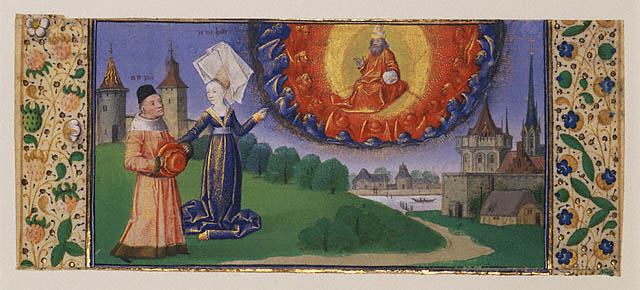 |
| Lady Philosophy leading Boethius towards his enlightment, Coëtivy Master c.1460/70 |
Whilst consoled by Philosophy, and occasionally chastised, for bemoaning his fate, or his lot, dependent upon the reader perceives how “consolation” (ie. Reason) is approached, ultimately (his) fate is not trapped in an unmoving present, where neither the future nor the past can be changed, but ultimately that a higher power, is outside of the remit set by time and is not an entity which possesses feelings, understanding nor personality. This higher power exists in an eternal present, not drawing upon the past nor predetermining a future. It is also an attempt to show a possible relationship between that of events being predetermined and that of destiny, and free will. Fortune is interpreted as being a turning wheel, and that each individual’s life is that very wheel, not just a spoke within it, or part of a greater, grand design. The fortunes of one’s life come and go, through the intervention of various forces; be they Providence or otherwise. It could be seen that life, in its entirety will have momentary pleasures and fortunes, is simply a background to which these opportunities and events will surface. Mediaeval Christians would have probably tied in with these teachings, although it is never specifically refered to nor cited, the Christian notion of "the meek inheriting the Earth."
As noted previously, Neo-Platonism is a principle underlying dimension to the work of Boethius, and not simply just a facet or an external influence that affected his writing and opinions. Neo-Platonism was developed in the third century AD. It’s ideology in some ways seems very similar to that, or as an expansion upon the doctrine of Simon Magus, and some of the Gnostic schools that followed. It put forward the notion that an all-Supreme deity, the One, from which emanated the divine Intelligence [or nous], and below that the soul of the world. Some of the souls remain in the celestial plain, and others descend into the bodies below. The soul however could ascend the hierarchy and eventually with, and be part of, the One. The teachings, developed by Plotinus, were influenced by a number of earlier schools of philosophy; such as those of Aristotle, and Pythagoras. Neo-Platonism was to become the most popular philosophical school by non-Christians, and was later to make resurgence in mediaeval and Renaissance thought.
As to the question of Boethius’ guilt in the accusation levied against him of conspiracy to commit treason, or to actually be party to it, or whether he was a man wrongly accused, is a difficult subject to discuss as the sources which are available all express the same bias. The primary source we have of the events leading up to his imprisonment is none other than Boethius himself. Naturally this autobiographical account of the wrongdoing meted out to him is going to be prejudicial to say the least, however, Boethius’ recounting of events leading up to his imprisonment do betray certain sympathies that could betray his actual guilt in the matter, rather than exonerate him. Furthermore, they draw into question the sympathy that should be afforded him, and whether Lady Philosophy’s arrival, like a deus ex machina, is in fact there to cover for or to create a defence (posthumous or not) for a seemingly rational man, hiding behind rationalism, to disguise or hide his own culpability.
Another primary source for the events surrounding Boethius and his condemnation is the Anonymous Valesii, a fragmentary chronicle of unknown origins, yet believed to have been composed some 20-30 years after Boethius’ execution, possibly in Ravenna. Certainly the contents of Boethius’ pleadings of innocence fall into line with those written in The Consolation of Philosophy. However, it cannot be determined whether the author of the tract had access to Boethius’ writings or not, and whether he was writing directly from The Consolation of Philosophy as his source. Procopius, author of The Secret History, writes in similar vein and again, possibly again using Boethius as his source, thereby making his bias immediately apparent.
Boethius’ successor as magister officiorum was Cassiodorus [or Flavius Magnus Aurelius Cassiodorus Senator], himself a former consul and governor of Sicily. Cassiodorus’ approach to history and philosophy was of marked difference to that of Boethius however. Both men recognized the importance of Greek and Roman literature, however Cassiodorus considered that the works of Scripture to of considerably higher import. Furthermore, Cassiodorus appears to have placed a more emphatic relevance to the Neoplatonist ideology of the form of the Good [τοῦ ἀγαθοῦ ἰδέαν]; a “symbiosis” of ideas between that ideology and that of beauty. In writing about the trial and ultimate execution of his predecessor, Cassiodorus is conspicuously silent and makes no mention or allusion to those events. This is extraordinary in that he penned a series of letters, the Variae Epistulae, which cover numerous aspects of Theodoric’s reign. This gap in his writing has been the subject of conjecture by scholars, whether this is an implication of the guilt of Boethius, or of his innocence. The Variae themselves speak highly of those individuals of whom Boethius suggests to be disreputable. Both his accuser, Cyprianus , as well as two of the “witnesses” called are cited as being men of good character. It needs to be noted however that experts do tend to approach the historical works of Cassiodorus with prudence, for he seems to have exercised caution when writing his works, more specifically for the sake of self preservation rather than recording the specific facts.
 |
| The Wheel of Fortune, as represented in the Carmina Burana |
The Consolation of Philosophy was to prove to be one of the most popular works of Mediaeval literature, alongside Geoffrey of Monmouth’s Historia, and Jacobus de Voragine’s The Golden Legend, and was translated and printed in many languages following the invention of the printing press. Certainly Boethius was received by a significantly sized, Christian audience. The narrative is simple in construct, yet the ideas profound; the structure is prosimetrical; alternating between prose and metered poetry. One of the most profound influences on the book and its approach is the works of Plato, of who’s works Boethius was compiling a compiling a commentary, prior to his imprisonment and eventual execution. The Christian audience of medieval times saw this work as instruction, discouragement from worldly goods and vices as money and power were merely temporary things but to focus, through the intervention of philosophical thinking, upon values, virtues, and of good. A path to virtue was through the suffering of inflicted evil, and despite adversity, to be able to overcome it and accomplish good, and through such action, one would reach peace and unity with God. Not only can Man exercise free will, but the ability to act upon that free will. The work also acted as a guide to provide encouragement and incentive to it's readers, invited to understand and seek consolation in the words of Boethius, emanating from the lips of Lady Philosophy.
The Consolation of Philosophy has left an important legacy for readers since its completion and circulation from the sixth century onwards. The work has inspired numerous writers, not just in the Mediaeval and Renaissance era when at its most popular; the both has influenced Dante, Chaucer, Shakespeare, to recent writers as diverse as J.R.R. Tolkien and John Kennedy Toole. It was translated many times, amongst its notable translations having been made by Alfred the Great, Chaucer, and queen Elizabeth I. Numerous translations have been circulated throughout the ages and the work is still available today; a true testament to the work’s enduring appeal and popularity in the present as much as in the past.
Subscribe to:
Posts (Atom)