
This condemnation of this period has somehow stuck in most people's subconscious, and therefore "mediaeval" cannot be regarded as an unbiased, neutral term for a particular era. The term itself, much like the even more condemning “Dark Ages” or laudatory “Classical Era” expresses, deliberately or not, approval or disapproval rather than being a description without prejudice. The reason for it having been so prevalent and having remained in usage is due to the Humanists who did not dismiss nor disregard this era as being insignificant, but important as a cornerstone to the foundations of modern development and growth. When classical literature and philosophy became more widespread and read, if not entirely understood, coupled with more widespread literacy and education among the population of Europe in the nineteenth century onwards, together with the publication of works by scholars like Edward Gibbon; a symbiosis was seen between the present and the classical era which were seen as more “contemporary” in ideology, than that of the Middle Ages, deemed almost “primitive” in comparison.
The term “Middle Ages” is a retrospective labelling of an important era in our history. Certainly no one during that period would have seen themselves as living in the Middle Ages. Many terms relating to this period of history are modern creations, such as the moniker bestowed upon Edward Plantagenet, son of Edward III, king of England. During his lifetime, this prince of the realm was simply known as Edward of Woodstock, only subsequently has he been bestowed with the more recognised epithet of “The Black Prince.” Again in England’s turbulent history, there were many years of a dynastic conflict between the descendents of Edward III, between two rivalling families, one of Lancaster, and one of York. These conflicts, subsequently named “the Wars of the Roses”, would never have been named as such at the time.
 | |
| The Bedford Hours, depicting the now popular perception of the Mediaeval era. |
The initial term was coined by Humanists in reference to an absence of classical Latin and Greek inspiration in the education of most Western Europeans. The rediscovery of classical ideas, primarily to be found in the literature of the non-Christian civilisatations of Greece and Rome, was studied and re-incorporated into culture with an astounding intensity by initially Italian scholars in the fourteenth and fifteenth century. This intensity would spread into other mediums of art and culture, giving eventual rise to the Renaissance. The Renaissance, although of equal standing in terms of piety and religious devotion, allowed the earlier pagan ideas and imagery to penetrate the previously staunch, unmovable Christian ideals set out by the Church and its followers.
During the Renaissance, Europe underwent religious upheaval and change with the advent of Protestantism and Humanism. By the end of the sixteenth century, a number of kingdoms previously been Catholic in their doctrine were now divorced from such ideas. The subjects of these kingdoms in Northern Europe (such as England, the Netherlands, Scandinavia) upon visiting the Catholic, Romance language speaking south would now encounter a creed at odds to their own, embracing beliefs that would seem primitive and archaic. These beliefs included showing reverence for dogma presided over by morally corrupt Popes and their representatives, the need to worship and venerate relics of so-called saints and the instilling of supernatural properties in such objects and remains, as well as praying for the dead and a belief in a soul in Purgatory. In order to understand the Middle Ages it is essential to be aware of this omnipresent, omnipotent and unified Church as a presiding force, not a mere backdrop to a Mediaeval “stage.”
Catholic theology and doctrine was deeply intertwined in the lives of the Mediaeval people. This thought process was to be subseuquently condemned by the later, “modern thinking”, Protestant historians. This condemnation echoed earlier events in history; the Early Church and its Christian followers had condemned the pagan past of the Roman Empire which it had essentially usurped. This condemnation continued in the "need to convert", demonstrated in the conversion of the Celts, the Vikings, and later the native southern Americans by the Conquistadores. In the seventeenth century, it was undesirable as well as unpopular to appreciate the advances and ideas that were made during this period. Only at the start of the eighteenth century did the Middle Ages start to be re-evaluated and not seen as the barbarous period which had been impressed into many people’s subconscious as being. It was still seen as being a "dark" period of history, where the Renaissance had not only awakened new religious ideas, but also brought about the discovery of the New World, encouraged discovery, growth, development and a wider spread of literacy and education.
The seventeenth century writer, Voltaire, was to condemn this period with scorn and disdain, not least for feudalism was seen as being nothing more than an excuse for the breeding of civil war between nations. Much as the Renaissance had allowed for previously condemned classical, non-Christian motifs and ideas, such as Neo-Platonism and likenesses of Greek gods in sculpture and painting, to enter into the social spheres and mindset of the educated, a similar phenomenon occurred from the eighteenth century onwards in relation to the Middle Ages. A turning point was when Walter Scott wrote Ivanhoe, a classic of English literature set against a mediaeval timescale. The world of King Arthur and Camelot was re-invoked in the poems of Tennyson in his Idylls of the King.
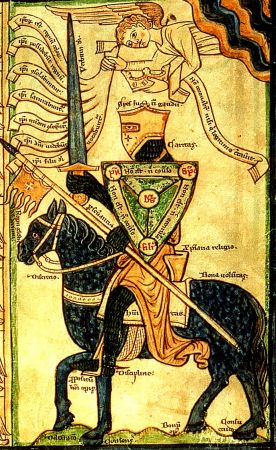 | ||
| The mediaeval chivalrous knight regained popularity with the publication of Ivanhoe. |
Ever since this appreciation and acceptance of the Middle Ages begun; numerous writers, historians, artists and in more recent times playwrights and film makers have sought to further evoke this captivating and fascinating period of history. This vast scope of available media is evident, ranging from the ready availability of mediaeval works, from pious texts such as those of Julian of Norwich, histories of Geoffrey of Monmouth or Bede, or the bawdy tales told in the pages of Boccaccio’s Decameron. A populararity entertained by choral groups such as the Tallis Scholars, or the Gothic Voices, whether singing solemn masses, troubadour songs invoking courtly love or otherwise, allows for a modern audience to enjoy the diversity in the music of this period once again. In the best seller lists of popular fiction, one will find established novelists such as Philippa Gregory, or Romain Sardou, all seeking to evoke this period in their writing. There are plentiful history books focussing upon this time or specialising in an interpretation of particular events, monarchs, wars, ideas, etc. In the written format alone, there would enough to probably fill an entire library.
This article is not intended as an overview of the mediaeval mindset, nor an attempt to understand the psychology and reasoning behind such processes, written along the lines of Carl Kerényi’s The Science of Mythology, written in tandem with Carl Jung, to compliment the latter’s understanding of the psychology behind religion be it classical, Buddhist, Christian or otherwise. The main purpose of this article is to pick up on a few of the aspects of the world of the Middle Ages, and to expand upon them. This is not an attempt at an overview or analysis of the period. For subjects within this wide field, such as the various different forms of allegory (vividly explained in works as The Elizabethan World Picture by E.M. Tillyard, or The Allegory of Love by C.S. Lewis) ; the use of imagery and symbolism; or of hermetic thought, such as that of Giordano Bruno (covered magnificently by Frances Yates in her Giordano Bruno and the Hermetic Tradition [Routledge, 2003]), they will doubtless be covered elsewhere in the course of this “blog” as it develops and time progresses.
This article is not intended as an overview of the mediaeval mindset, nor an attempt to understand the psychology and reasoning behind such processes, written along the lines of Carl Kerényi’s The Science of Mythology, written in tandem with Carl Jung, to compliment the latter’s understanding of the psychology behind religion be it classical, Buddhist, Christian or otherwise. The main purpose of this article is to pick up on a few of the aspects of the world of the Middle Ages, and to expand upon them. This is not an attempt at an overview or analysis of the period. For subjects within this wide field, such as the various different forms of allegory (vividly explained in works as The Elizabethan World Picture by E.M. Tillyard, or The Allegory of Love by C.S. Lewis) ; the use of imagery and symbolism; or of hermetic thought, such as that of Giordano Bruno (covered magnificently by Frances Yates in her Giordano Bruno and the Hermetic Tradition [Routledge, 2003]), they will doubtless be covered elsewhere in the course of this “blog” as it develops and time progresses.
 |
| An illustration from the 19th century, Kelmscott printing of Chaucer |
Despite the widespread illiteracy and low level of education of a sizeable proportion of the population, a significant quota of classical literature would have been available to those well enough educated to read it. It has been argued that the early Christians did not value nor appreciate these works. There are horror stories aplenty surrounding the early Christians, such as those involved in the destruction of the Great Library and Serapeum in Alexandria in 391 AD. Or the mindless murder of great thinker Hypatia by a Christian mob acting under the instructions of their leader, Cyril, later beatified as a Christian saint. Numerous temples to pagan gods were desecrated and either destroyed or embellished with Christian motifs. Greek thought, writing and teaching was largely forgotten and neglected. Owing to the usage of Latin as a judicial language as well as that of the Church, much more Roman writing survived. Most of the myths and stories in Greek and Roman religion were symbiotic; in fact most Roman mythology mirrored that of the earlier tales from Greece, just with different names for individual deities and heroes. It was the religious messages of morality behind such texts that was lost, rather than the texts themselves. This is not to say that all texts were appreciated and preserved. Many were indeed lost and only some were not rediscovered until many years later, in the Renaissance and beyond.
A fundamental aspect of mediaeval art and prose appears to have been to make the proponents or personalities contemporary and identifiable with its intended audience, either by through appearance or conduct. In simplistic terms, in relation to most drawings and paintings, the costumes worn tend to reflect those of the era in which they were painted in, rather than any effort or attempt to capture a bygone period or for historic authenticity. For example, the paintings of Biblical scenes by artists such as Dieric Bouts, Jean Fouquet or Piero della Francesca, to name just a few examples among so many, portray Biblical personalities in contemporary dress. In literature, such as in Thomas Malory's epic, Morte d’Arthur, the Camelot era evokes the splendour of fifteenth century England or France rather than the fifth or sixth century period in which the tales are supposed to be played out. This style, however, is not the same as a present day century audience watching a period drama, or reading a historical novel with the protagonists speaking in modern parlance, although parallels can be drawn. The current reasoning is so as to create a mood or landscape in which the viewer or reader will identify with belonging to a particular time, yet making its inhabitants speak in a language that can be followed rather than lead to unnecessary confusion. These rules have been bent from time to time, depending upon the vision of the author or artist. A recent example was the filming of The Passion of the Christ, by Australian actor/director, Mel Gibson, who chose to film the entire film in Aramaic and Latin. Another example is found in productions of Shakespearean plays which are on occassion performed in modern or contemporary dress despite the play retaining it’s early modern English dialogue. In the Ethiopian Christian church, representations of the Madonna and Christ are frequently painted as being black rather than having Semitic looks. This concept is not as extraordinary as it might appear; one just needs to look at the majority of Christian art to see the same idea is and was found in Western art as much as in Eastern.
 | |
| Hans Memling's 15th century vision of the Passion and Crucifixion. |
The understanding of the workings of religion and devotion are essential to the comprehension of the mediaeval mind. Other than a select few, no one would dare stand in opposition to the all powerful Church. Even from birth, not to have been baptised would mean eternal condemnation in the afterlife. The soul would reside in Limbo mirroring a similar existence endured by the Lotus Eaters in the Underworld of Greek mythology, or afforded to those buried without a coin under their tongue to pay for Charon to ferry them across the Styx. These souls were eternal shades waiting on the river's shores, never given the opportunity to cross into the afterlife.
The punishment for those who did not believe was to face excommunication, and by extension, damnation by God and generally from one's peers. In Dante’s Inferno, the author and narrator converses with Cavalcante de Cavalcanti, a Florentine philosopher and father of Guido Cavalcanti, the father of a close friend. The elder Cavalcanti had been denounced as a heretic, despite his supporting the Guelphs, supporters of the Pope. However both father and son declared themselves to be atheist in their beliefs. In the course of the narrative, Dante and Virgil encounter Cavalcanti, and converse with him in the sixth circle of Hell, where he resides alongside the other heretics among the flaming tombs. Dante’s portrayal is as that of a sympathetic, loving father, before Cavalcanti fades once again into the sepulchre.
The punishment for those who did not believe was to face excommunication, and by extension, damnation by God and generally from one's peers. In Dante’s Inferno, the author and narrator converses with Cavalcante de Cavalcanti, a Florentine philosopher and father of Guido Cavalcanti, the father of a close friend. The elder Cavalcanti had been denounced as a heretic, despite his supporting the Guelphs, supporters of the Pope. However both father and son declared themselves to be atheist in their beliefs. In the course of the narrative, Dante and Virgil encounter Cavalcanti, and converse with him in the sixth circle of Hell, where he resides alongside the other heretics among the flaming tombs. Dante’s portrayal is as that of a sympathetic, loving father, before Cavalcanti fades once again into the sepulchre.
The foundation of the numerous monasteries and the foundation of different Orders acts as testament to the importance of the sacred life during the Middle Ages. Despite the need for many kings to form alliances and expand upon their empires through inter-dynastic marriages, most monarchs required at least one of their sons would enter the clergy, and that one daughters become a nun. In Anglo Saxon England, many princesses joined the clergy and become prioresses or abbesses owing to their venerated and royal status. In certain instances, when a queen consort outlived her husband, she would undertake a vow of chastity and become a nun for the remainder of her days. Having served her king and husband, she now sought chastity and penance. Monastic life was intended to be simpler, yet more austere and more devout. The Rule of the Benedictines, one of the earliest mediaeval monastic schools, was to become the code for almost all monasteries in the Christian world by the year 1000. The monstic year was centred and shaped by the Liturgical calendar, and each day was focused upon devotion and prayers. Despite the sworn rite of poverty taken by the brotherhood, the Benedictines became extremely wealthy. Much land had been conferred to the order in return for blessings and prayers requested by wealthy patrons. A more austere movement, the Cistercians, was formed, in c. 1098 by Bernard of Clairvaux, a passionate and charismatic figurehead who encouraged and supported the Crusades against the infidels, and vehemently assailed those accused or whom he believed guilty of heresy.
Mediaeval Christianity did not rest upon a creed, much like modern religion and faith does, but more upon devotion and adherence to religious customs. Granted detractors from the religious doctrine risked being excommunicated and in some instances, execution for heresy; this does not appear to have been the heart of their belief system and religion. The sacraments played an important role in the salvation of the soul from baptism at birth through to confirmation and marriage in later life. The soul of the individual was not decided directly by one’s own behaviour in life, but could be affected by the prayers of those still living after one’s death. Good deeds such as kindness and virtue as well as generosity to the poor were worthy of merit, but so too was punishment and infliction of suffering upon one’s flesh. These acts included flagellation, or fasting, in order to ensure suffering in Purgatory in the afterlife could be lessened through suffering in life on Earth. This belief in salvation was prevalent in all strata of society; notable examples being the tsar Ivan the Terrible wearing a cilice before his death, wishing to die in the humble apparel of a monk, and of Sir Thomas More, garbed in a hair shirt under his costly robes.
Mediaeval Christianity did not rest upon a creed, much like modern religion and faith does, but more upon devotion and adherence to religious customs. Granted detractors from the religious doctrine risked being excommunicated and in some instances, execution for heresy; this does not appear to have been the heart of their belief system and religion. The sacraments played an important role in the salvation of the soul from baptism at birth through to confirmation and marriage in later life. The soul of the individual was not decided directly by one’s own behaviour in life, but could be affected by the prayers of those still living after one’s death. Good deeds such as kindness and virtue as well as generosity to the poor were worthy of merit, but so too was punishment and infliction of suffering upon one’s flesh. These acts included flagellation, or fasting, in order to ensure suffering in Purgatory in the afterlife could be lessened through suffering in life on Earth. This belief in salvation was prevalent in all strata of society; notable examples being the tsar Ivan the Terrible wearing a cilice before his death, wishing to die in the humble apparel of a monk, and of Sir Thomas More, garbed in a hair shirt under his costly robes.
 |
| The 12th century Palatine chapel in Palermo, Sicily; a lasting testament to Mediaeval religious devotion. |
The Church in the Middle Ages was rigid and unflinching in its ideas. Departure from the official doctrine and teachings were simply not tolerated, and condemned. The Jews were mostly accepted, yet frequently subject to persecution, treated as social pariahs in various kingdoms, and blamed for their ancestors’ part in the crucifixion of Jesus Christ. The Moors (or Berbers) were tolerated in certain parts of Spain. Unorthodox theories were stamped out and condemned, with charismatic teachers and reformers such as Jan Hus, Giordano Bruno and John Wycliffe being condemned and ultimately executed for heresy. Initially this purge took place in the burning of their works but this lead to the Church in its frenzy to eliminate the perpetrators of such beliefs rather than their works alone. Certain heresies attracted the attention of the Church, and were crushed with all its followers exterminated. The most infamous example of this was in the instance of the Albigensian Crusade, which effectively eradicated the Cathars from the Languedoc region in France; the most notorious episode being the so called Massacre of Montségur in March 1244.
Together with the practise of the seven sacraments, still adhered to in the Catholic faith today, was the following of a fellowship of select and devout Christians whose deeds throughout their lives had a assured them of a place in heaven viz. saints. This collected body of saints were primarily made of up of the apostles, the Evangelists and martyrs, and who's sainthood was accepted upon the basis of legends associated with their lives and deeds, legendary and historical. This process of sainthood was to change in later years and had to be formalised by a papal court, which it still is today. Saints, as well as their remains, were a vital part to the Mediaeval Christian’s faith, and were often petitioned by their followers in which vows could be made, and gifts bestowed in return for blessings. A further demonstration of worship in mediaeval life was shown in the undertaking of pilgrimage(s), usually to Rome, to Jerusalem or to Santiago de Compostela.
 |
| King Arthur, whose popular tradition was born of legend, history and Mediaeval idealism. |
The role and concept of kings were another important part of mediaeval life. These men were believed to have been chosen and appointed as leaders by God, and their presence on the throne was confirmed by the Church. This doctrine of divine rule extended all the way back to the Old Testament. The king was required to make oaths of allegiance upon his accession to the throne and at his coronation, otherwise he could be deposed. The idea of rebellion against the monarch was seen as being sacrilege, not to mention treason. Despite having absolute power over the land, kings did not govern their countries alone and guided by advisors, councillors and leading subjects, often wealthy landowners, friends and confidantes. The notion of absolute monarchy however was not confined to the Middle Ages. This system of government was to carry on before the power of individual sovereigns in their kingdoms were curtailed by their governments over the passage of time. One of the latest European countries to relinquish the absolute powers of its monarch was Russia in the 20th century, culminating in the overthrow of its last tsar, Nicholas II, in 1917.
Literature, art, and music were as important as they are today. It has wrongly been suggested that, owing to the overwealming presence of the Church in everyday life that thee were required to be exclusively sacred in content. This proposition is based on that a significnt proportion of art and paintings were of religious subject matter; music being devotionl chant and masses; and most all writing was that of religious experience or reflection.
Music was initially only of a liturgical nature at the beginning of the Mediaeval era. Among the earliest musical settings for a mass were that of Gregorian chant, a form of plainchant or plainsong. Plainchant itself dates to the third century. Gregorian Chant has monastic origins, first surfacing in the sixth century, being a simplistic form of monophonic music used in liturgies. The chant itself remained a predominant tradition within church services for many centuries, as the dominant platform for the settings. Even with the introduction of new texts however the context remained static. This style of singing had been heavily influenced by the tradition of singing psalms in Jewish synagogues. At the start of the eleventh century, the Church sought to standardize the way in which mass was sung with Gregorian chant was encouraged throughout Europe. This form of chant was soon to be ubiquitous throughout churches with only a few exceptions.
Music was initially only of a liturgical nature at the beginning of the Mediaeval era. Among the earliest musical settings for a mass were that of Gregorian chant, a form of plainchant or plainsong. Plainchant itself dates to the third century. Gregorian Chant has monastic origins, first surfacing in the sixth century, being a simplistic form of monophonic music used in liturgies. The chant itself remained a predominant tradition within church services for many centuries, as the dominant platform for the settings. Even with the introduction of new texts however the context remained static. This style of singing had been heavily influenced by the tradition of singing psalms in Jewish synagogues. At the start of the eleventh century, the Church sought to standardize the way in which mass was sung with Gregorian chant was encouraged throughout Europe. This form of chant was soon to be ubiquitous throughout churches with only a few exceptions.
 |
| The Arundel Choirbook, showing the advances made in music in the Middle Ages. |
A couple of centuries later, a new style called organum was developed and introduced, which added additional voices to the then monophonic arrangements, and this in turn was to lead to the birth of polyphony. Among the first composers to use this new style was Léonin, who pioneered and may even have initiated the organum movement in Notre Dame, in Paris. Our knowledge of this new style comes from the accounts of a thirteenth century English monk or scholar, possibly from the monastery of Bury St Edmunds, who’s name to this day remains unknown, bestowed the title of "Anonymous IV" when his treatises detailing two of the most important composers of music in the late twelfth century were first published in the nineteenth century. The anonymous author recounts the achievements of Léonin, and his contemporary Pérotin, both of whom probably died some fifty years prior to Anonymous IV writing his account, in such glowing terms that it seems probable that both composers were recognised and known by name, certainly on both sides of the Channel.
Léonin wrote a cycle of two part settings for the important religious feast days, such as Easter and Christmas in his book called the Magnus liber organi [‘The Great Book of Organum’], possibly with the assistance of another composer named Pérotin. Pérotin’s work is similar in nature, as a more abbreviated form of the works by Léonin. We have no biographical details for either of the two composers. It has been been proposed that Léonin could be identified with a contemporary Parisian poet. From this musical style developed into the usage of several voices singing independently (polyphony).
Secular music nonetheless evolved, and this style of music followed the development of popular themes, being sung by travelling minstrels and initiated a style of music by the troubadours. These troubadours’ songs arose from the proliferation of Occitan poetry in the twelfth and thirteenth centuries. The songs were not religious in theme and sang of chivalry and courtly love, and could be at times suggestive and subversive in their subject matter as well as being intellectual or narrative driven, to recount a tale or an event. The popularity and writing of these Troubadour songs reached its zenith between 1170 and 1220 before fading out a century later.
Secular music nonetheless evolved, and this style of music followed the development of popular themes, being sung by travelling minstrels and initiated a style of music by the troubadours. These troubadours’ songs arose from the proliferation of Occitan poetry in the twelfth and thirteenth centuries. The songs were not religious in theme and sang of chivalry and courtly love, and could be at times suggestive and subversive in their subject matter as well as being intellectual or narrative driven, to recount a tale or an event. The popularity and writing of these Troubadour songs reached its zenith between 1170 and 1220 before fading out a century later.
The Middle Ages saw the development of a system for the writing down of music as previous forms had been uniform and remained static for many years. Upon the creation of this uniformity of noting down music, it allowed for music to become more complicated in construction, paving the way for orchestral music and complex polyphonic arrangements in the masses which became increasingly popular in the Renaissance and beyond.
One of the most fascinating and intriguing aspects of the Middle Ages is one which has left no archaeological traces nor tangible record, and that is the workings of the human mind. Learning and scholarship during this era was initially confined and centred around monasteries. Within these centres of learning, the collection of books would be dependent upon the size and scope of the collection of the books within the library. Works were only transmitted if they were deemed suitable for copying by others, and if the Church or the monastery did not deem the work worthy or suitable for this transmission, it would fade out and disappear. Monastic communities were insular and although their studies impressive in contrast to their peers outside the walls of the monastery, focus tended to be more on theology and history than science, philosophy, rhetoric, languages and classics.
Outside of a monastic setting an education system did exist and was more readily available. Education systems begun to be established in large towns and cities during the Middle Ages, leading to foundation of schools and ultimately, universities. The most important centres of this new learning were located in Paris and Bologna, specialising in philosophy and legal studies respectively. Other centres of learning took root and sprouted up elsewhere in France, in the four Maritime Republics and in European kingdoms such as England and Spain. These universities proved very popular and took on the format of an institution that is immediately recognisable today. They consisted of recognisable elements in their makeup including students, academics, lectures, exams and degrees. The doctrine and method of these schools was to encourage a scheme of thought which was dubbed “scholasticism.” Outside of the Bible, the university environment encouraged the learning and analysis of other, authoritative texts and writings, such as those of Aristotle. Scholars and scholastic thinkers were encouraged to have ideas, although these would have to fall into line with those teachings encouraged by the Church; one of the works to arise from this encouragement of such thought was the Summa Theologiae [The Outline of Theology] by Thomas Aquinas. Aquinas discussed the existence and nature of God, angels, demons, as well as good and evil, the law, human mortality and death. This breakthrough work represented an important endeavour to align Scriptural matters and teachings with those of philosophy.
Although technology was limited, the Middle Ages allowed for significant advancement in scientific thought to inspire the creation of various innovations and inventions. It certainly set the metaphorical wheels in motion to allow for the development of such ideas. Inventions included the clock, an important tool that allowed for the universal measurement of time. Not to say all inventions were encouraged and endorsed however, the contemporary reader need only look at the reception which Galileo received from the Church in relation to his astronomical discoveries made with his own telescope. These discoveries flatly contradicted the doctrine of the Church. The ensuing condemnation by the religious authories allows one to afford a glimpse of how restrained intellectuals and scholars were in being allowed to embrace this new found "freedom" and sponsorship from the Church.
 |
| Cambridge University, one of the world's oldest and longest established centres of learning. |
The educated still continued to hold the belief that the universe was still a creation of the almighty Biblical god, constructed in six days. Despite the fact that Man had eaten from the Tree of Knowledge in the Garden of Eden, everything was nonetheless centred around him and his being. The cosmos was seen as a series of concentric spheres, and in the centre of these, and by extension everything, was the globe of the Earth. Orbiting the Earth were seven crystal spheres holding the seven Planets (the Sun, Moon, and five known planets). Beyond these planets was a sphere of fixed stars, revolving every twenty-four hours. Outermost to these stars was the Primum Mobile, divided into three spheres. These spheres were the Crystalline Heaven, the First Movable, and the Empyrean (the highest Heaven). These spheres were moved by the Prime Mover, translated into mediaeval terms as the Christian God, and these spheres moved in perfect harmony, generating the "music of the spheres", inaudible to man who inhabited the sublunary sphere of corruption. Hell was found in the centre of the Earth, and Heaven was above and beyond the spheres.
This cosmology was based around the teachings of Ptolomy (c.150 AD), who in turn had based his theories of Aristotle, written some four centuries previous. The earth and planets inhabited a sphere, named the sublunary, that was changableable and corruptable; above which was the celestial, incorruptable and perfect in nature, and finally, the supercelestial, inhabited by the Godhead and the angels. The idea of the earth being the centre of the universe was later discredited and disregarded, following the acceptance of the theories proposed by Copernicus. However, the idea and thinking behind these worlds were still used in allegorical literature such as Le Roman de la Rose and Spenser's epic poem, The Faerie Queen.
Astrological beliefs were intertwined with those of astronomy, and were afforded condemnation and praise in equal quota. To the Christian mind, it seemed inconconcievable that the stars and their positioning in the heavens could be influential of human behaviour, determinate of those actions in the present as well as the future. If everything had been pre-determined by nature, this theory questioned the nature of freewill and moral responsibility for one’s actions. An explanation was given allowing for this to be possible by a German thinker, Albertus Magnus. Magnus was subsequently deemed a Doctor of the Church. He stated that if the stars determined the behaviour of a person owing to their specific placement in the sky at any given time, it was ultimately the decision of man to decide whether to act upon such impulses. For fear of excommunication, the universe and its creation were never questioned, it was just accepted as being God’s creation.
 |
| The spheres between Heaven and Earth, c. 1470. |
Geography and understanding of the world and its populations was limited. The Earth had been identified as being spherical in nature, yet understanding of the actual physical geography was limited and uncertain. All mediaeval maps placed the city of Jerusalem as being in the centre of the Earth, and although maps have survived from this period, they are grossly inaccurate as one travels further outside of the European continent. The Anglo-Saxons were more inclined to write their maps than drawing them. John Mandeville wrote a celebrated travelogue detailing his alleged adventures around the world. The work is prone to elaboration, at times fantastic and unbelievable in its content. However, despite the embellishments and need to create fantastic stories and tales, certain elements of truth found within his chronicles suggest a possibility that Mandeville did indeed visit these places as claimed.
The study of alchemy was expounded upon in the Middle Ages, and would carry on into the Renaissance and beyond. The motivation behind this "science" has been dismissed by some scholars as being that of greed, and the desire to create gold; a valuable and spiritually charged mineral. Granted, this may have been a contributing factor to its popularity. However in applying an understanding of mediaeval philosophy, it is equally likely that the conversion of a base metal to gold was centred in the belief that everything, be it animal, vegetable or mineral was placed upon a scale towards spiritual perfection. On this scale, gold was deemed to be the most perfect and the belief that it was incorruptible. Transformation was believed possible on most all levels and that the quest to create gold mirrored that of achieving spiritual perfection. Alchemy was the art of purging of impurities from one’s being, as much as that of the base metal, leaving something splendid and pure. At the same time, knowledge and understanding of these practices were thought of tampering with nature and interfering with God’s creation. Alchemy was therefore outlawed by the Church as well as being seen as magical and unnatural. A correlation was made between science and magic, and if such knowledge was abused, this was deemed witchcraft, and its practioner having entered into an unholy alliance with the Devil.
Logic rested upon the foundation of axioms; axioms being unchangeable premises from which debate and argument can proceed. This logic can be demonstrated in the scientific field of mathematics, such as that proposed by Euclid, who had developed incontrovertible proofs to demonstrate his theories. However, in mediaeval thought, these axioms were no longer based upon scientific rationale and understanding, but were grounded in a theological basis, in that what occurred was predetermined as part of some grand design by God and his emissaries rather than logical progression. Axioms adopted therefore decided the context in which the argument develops, and by extension define the framework in which it takes place, all of which was seen as being part of “God’s Plan.”
Finally, mediaeval thought was dominated by the theory of correspondences. This idea, intriguingly enough, was not one which found its origins neither in Biblical nor Christian thought, but was Greek in origin, having been proposed by Galen that an explanation, so as to be part of a divine plan, needed to be symmetrical, aesthetically satisfying and economical. In simplistic terms, it was believed everything in the Universe was made up in of the four elements:- Air, Earth, Fire and Water . These four elements corresponded with four fluids within the human body – blood, phlegm, yellow bile and black bile, and these four fluids, in correlation with the seasons, produced four Humours according to the proportions in which they were mixed. These humours were sanguine, phlegmatic, choleric and melancholic. The correlations can be summed up below:-
AUTUMN = Black bile = Melancholic = Earth
SUMMER = Yellow bile = Choleric = Fire
SPRING = Blood = Sanguine = Air
WINTER = Phlegm = Phlegmatic=Water
The association with number four was of special significance; this numeric connection was tied in to the four winds, the four cardinal directions, the four Evangelists, the four Gospels and this reinforced the validity of such a theory in the mediaeval mindset. Balance of these humours was achieved through diet, medecine, and phlebotomy [blood-letting]. Medicines were generally herbal concoctions and were not solely intended as remedies with healing properties. Corresponding with the theory of the humours; plants, household goods and foodstuffs were seen as being cold, warm, dry or wet and these could also be applied so as to modify the quantities of the respective humour within the body as required.
Phlebotomy allowed for the control of a specific humour to particular areas of the body. The patient had to be bled from a specific vein relating to a specific organ, This theory was based upon the concept that certain organs could not be directly reached such as the brain and heart, that bleeding from a specific vein would draw the noxious vapour from the otherwise inaccessable bodily region. This administation of blood letting took place either via derivation (directly from a vein close to the source affected) or revulsion (the most remote point from the affected area). The most popular handbook to mediaeval readers was the Tacuinum Sanitatis, which in itself derived from an 11th century Arab medical treatise.
James Hannem, author of God’s Philosophers [Icon Books 2009], has dismissed the suggestion that modern science and scientific thought was directly influenced by the teachings of the ancient Greeks, but was born in the early medaeval era, not in the pagan environments of Athens or “mystery schools” of Alexandria. Hannem postulates the theory that in fact the most productive and inventive growth in man’s scientific knowledge was to take place in 500 AD in the budding mediaeval era. His theories suggest that most of the Alexandrian schools of late antiquity were simply reiterating theorie suggested previously, such as in the case of astronomers like Ptolemy being undeserving of the accolade “the Great”, for their (apparent) advances in the field of astronomy. In short, Hannem further empasises that although the Greeks enjoyed intellectual freedom; this does not mean that they were responsible for the launch of what might be deemed modern scientific analysis and thought. However, Hannem's work needs to be approached with caution, although the ideas and suggestions he makes are interesting and make for an entertaining and lively read, he allows his own Catholicism to tarnish and influence his judgments. One example of this is that it becomes immediately apparent that the mediaeval (natural) philosophs appear to have been more concerned with the expansion of theological and spiritual explanations for various “phenomena”, rather than drawing their attention to natural forces and the world around them. The mediaeval mind, perhaps under the fear of repercussions from the Pope and his Church, preferred to focus on the supernatural omnipotence of God, and by extension to the works and actions of angels and demons rather than seeking a logical, and by extension, scientific solution.
Phlebotomy allowed for the control of a specific humour to particular areas of the body. The patient had to be bled from a specific vein relating to a specific organ, This theory was based upon the concept that certain organs could not be directly reached such as the brain and heart, that bleeding from a specific vein would draw the noxious vapour from the otherwise inaccessable bodily region. This administation of blood letting took place either via derivation (directly from a vein close to the source affected) or revulsion (the most remote point from the affected area). The most popular handbook to mediaeval readers was the Tacuinum Sanitatis, which in itself derived from an 11th century Arab medical treatise.
 |
| An anatomy diagram depicting all the injuries body might sustain. |
 |
| A 1483 edition of Lucretius' once lost "On the Nature of Things" |
One of the most recent proposals made by scholars backing up this theory as one of the turning points as to when the Middle Ages evolved into the Renaissance has been discussed by Stephen Greenblatt in The Swerve: How the Renaissance Began [Bodley Head, 2011]. Greenblatt proposes the view that the re-discovery of the epic poem, “da rerum natura” [On the Nature of Things], by Lucretius, in the fifteenth century was the driving force behind a radical re-thinking of ideas, and this re-thinking, was instrumental in the conception of the Renaissance. Lucretius’ work had been believed lost for over a millennium, and was found by Poggio Bracciolini, a book-hunter with wealthy patrons. Placing this rediscovery, as well as the content of the work needs to be considered in the context of the minds of the educated audience for whom it had been found. The poem's content was more than was simply the rediscovery of a lost classic, like say, another works of Catullus. The controversial poem proposed that the Earth and heaven were not part of a hierarchy in the universe as a whole. Despite the seeming need to worship gods, these “pious gestures” were of no consequence, nor of any significance to the gods being worshipped. Everything could be explained as being down to natural causes rather than through divine intervention by a deity or godhead. Furthermore, Lucretius’ work questioned the existence of an afterlife, and that proposed the notion that everything in the universe was in fact made up of atoms. Everything begins as atoms and when life is over, it is to atoms that we return - Nil fieri ex nihilo, in nihilum nil posse revert [Nothing comes from nothing, and nothing can be reduced to nothing.]
Expanding upon this theory, there was no place or concept of an afterlife - no promise of Paradise to the virtuous, nor of damning torment to the sinful. The ideas presented were in stark contradiction and defiant to the message taught by the all powerful Church. This determinist philosophy is in stark contrast with the concepts of either fatalism (where everything is predetermined by Fate), or with the concept of choice and free will. With this ideology the ever sensitive Church sought, unsuccessfully, to have the work suppressed and forgotten. Instead, states Greenblatt, the opposite occurred. Greenblatt suggests that the discovery of this poem was to constitute a “swerve” in thought, much like the “swerve” of the atoms in Lucretius’ poem, which allowed for freewill. Perhaps somewhat exaggerating the import of the discovery and re-evaluation of the work, Greenblatt suggests that it had an overwhelming impact on history and allowing for the re-evaluation of the understanding of nature, of science and of God.
This theory of a subsequent reawakening or “enlightenment” of the imagination and of scientific thought after many years lying dormant, almost stagnant, has been proposed by Charles Freeman in The Closing of the Western Mind [Pimlico 2003]. Freeman suggests that following the advent of a mostly unified Christian “orthodox” church and the largely successful attempts to suppress pagan cults (and ideas), as well as those “undesirable elements” within the Early Church, including ideas such as Arianism, docetism, dualism, and the plethora of teachings that falls under the aegis of Gnosticism, allowing faith and its supernatural connotations were allowed to supersede logic and reason. Not that Freeman is correct in all of his theories in this work. Elsewhere, Freeman all too easily dismisses the notion of Gnosticism, in particular the texts (“the Gnostic Gospels”) found at Nag Hammadi with a brief sweeping statement. His dismissal of these texts is due to the only surviving copies were found in Coptic translation, and dated from the late fourth century; in addition to containing teachings of different forms of early Christianity that would appear alien to a modern reader. Therefore, these writings are seen as not possessing any historical validity nor value in understanding early Christian thought, the development of the Early Church and by extension the whole field of Gnosticism.
Freeman argues that Greek thought and culture was on an intellectual par and standing with that of contemporary modern thought today. Following the spread of the doctrine of Pauline Christianity throughout the Roman World in the early centuries A.D. and its “rubber stamping” and endorsement by the Emperors, the decline of rational thought took hold, and this decline was actively encouraged, with natural scientific theory deemed heretical and sinful. In short, faith triumphed over reason. As mentioned above, Thomas Aquinas would later encourage the idea of rational thought to be reinstated (yet in a constrained, almost abridged acceptable format) into the theological teachings of the day. Through the spread of learning and a greater desire for understanding in the Middle Ages, rational thought slowly took hold once again. Western Europe started to allow certain natural scientific theories to integrate with religious doctrine, rather than be feared, detracted and condemned, as had occurred over the centuries previous.


